
“A Well-Fitting Saddle Is Crucial for Your Horse’s Health.”
“A Well-Fitting Saddle Is Crucial for Your Horse’s Health.”
A well-fitting saddle is important for your horse’s welfare and has a direct impact on performance. When a saddle fits correctly, your horse can move comfortably and respond better to your aids. As a rider, you also want to sit comfortably in the saddle and be able to use your body to give the correct aids. That is why it is important to take the time to choose a saddle that fits properly. EURO-HORSE Saddle Fitting Service specialises in this and can help you make the right choice.
Horses are not naturally designed to carry weight and therefore need appropriate support to carry a rider. If you try to imagine what a poorly fitting western saddle feels like, think of carrying a fully loaded backpack. A backpack that is incorrectly or unevenly loaded, has straps that are too tight or too loose, or is heavily loaded without a frame is extremely uncomfortable. Not only will your back start to hurt, but your body will also try to compensate, for example by walking unevenly and becoming stiff throughout the body.
That is why a well-fitting saddle is crucial for your horse’s health. Of course, this does not mean that a well-fitting saddle can compensate for poor riding technique or physical problems in the horse. We still often see riders hoping that a correctly fitting saddle will solve every problem. Unfortunately, that is not how it works.
“A well-fitting western saddle will maximise your horse’s comfort and performance, but this will always depend on the horse’s overall care, health and training.”
A Snapshot in Time
When purchasing a saddle, many questions arise. One question we often hear is: “If I buy a new saddle now, how long will I be able to use it?” This is an understandable but difficult question to answer.
Saddle fitting is always a snapshot in time. Depending on your horse’s age and the type of training you do, we can estimate whether a particular tree that fits at that moment is likely to continue fitting for a longer period.
If your horse changes condition due to muscle development, muscle loss or hormonal changes, your horse may change enough for the saddle to no longer fit correctly. Changes in training, such as increasing or decreasing the intensity, or moving to a different stable with a different feeding programme, can also change your horse’s shape and condition.
That is why we always discuss your future goals with you carefully. Especially with young horses, it is almost certain that you will need to change saddles several times. However, this is not a reason to avoid purchasing another saddle. Once a horse is being ridden, the saddle must fit correctly.
Whether your horse is four or eighteen years old: never ride in a saddle that does not fit! Learned behaviour caused by an ill-fitting saddle, such as biting or bucking, can be very difficult to correct. And, of course, you never want to cause your horse pain.
Checking Your Own Saddle
If you already have a saddle and are unsure whether it fits correctly, we can visit you for a check of your own saddle.
Problems that should always prompt you to have your saddle checked include sores, swelling or rub marks underneath the saddle after riding.
Ideally, your horse should have an even sweat pattern underneath the saddle after riding. However, a completely straight and symmetrical horse does not exist. Just like humans, horses have a preferred side, and it takes a lot of skilled training to bring them as much into balance as possible.
An uneven sweat pattern therefore does not necessarily mean that you need a different saddle. In many cases, continued training may be the first thing that is needed.
Another important cause can be a dirty saddle pad. Dirt reduces the pad’s cushioning and moisture-wicking properties and can even cause injuries.
You should also have the saddle checked if your horse suddenly starts showing unpleasant or grumpy behaviour while being saddled or girthed.
It is also worth having the saddle checked if your horse regularly starts shaking its head while being ridden with a saddle, but not when ridden without one.
Does the head shaking occur mainly when your horse has to bend its body? This may indicate that your horse is experiencing discomfort from a pressure point caused by the saddle.
Head shaking is a complex problem with many possible causes, but it is certainly useful to be able to rule out the saddle as one of them.
“Some horses are much more subtle when it comes to showing signs that their saddle does not fit correctly.”
If you notice reduced muscle development along your horse’s back despite correct training and an appropriate feeding programme, your saddle may also be the cause. An ill-fitting saddle can create pressure that prevents the muscles from developing properly.
Some horses are much more subtle in the way they indicate that their saddle is not fitting correctly. Do you feel that your horse is not completely relaxed while riding, or perhaps that your horse resists during certain exercises? These can also be signs that the saddle does not fit properly.
A Saddle That Moves or Slides
There are essentially no high-quality saddles that are inherently crooked. If you are unsure whether your saddle itself is straight, place it on a straight surface, such as a table, and check it with a ruler.
If the saddle appears crooked when placed on your horse, it is very likely that the horse is crooked rather than the saddle.
Saddles can drop or sit crooked because a horse has a preferred side when bending its body. As long as your horse has not developed correct vertical balance, this problem can persist. The same applies if you, as a rider, are not yet sufficiently developed in your riding to train this correctly.
Uneven loading caused by a rider sitting crooked or being out of balance can also create a saddle that shifts.
Pay attention to the hooves as well. Uneven hoof balance can create an uneven posture throughout the horse’s body. Regular care from a good farrier is therefore important.
Sitting Comfortably
Besides all the requirements your horse has for a saddle, you naturally want a saddle that is comfortable for you as a rider as well.
Riders have different preferences when it comes to seat size. Some prefer a larger seat, while others prefer a smaller one. In addition to personal preference, the discipline you ride also plays a role in the appropriate seat size.
In general, you should be able to fit approximately three fingers between your thigh and the front of the saddle (swell), and a flat hand between the back of the saddle (cantle) and your seat.
There are different saddle types with corresponding seat styles, as well as different types of ground seats within each saddle style.
It is worth noting that the size of a western saddle refers to the rider’s seat length in inches and therefore says nothing about the saddle size required for the horse.
The most common western saddle size is 16 inches. If you are switching from English riding, you may need a different size in a western saddle than you are used to, because a different measurement is used.
If you have very long legs, you may need a larger seat so that your knees do not press against the front of the saddle.
Do not dismiss a particular seat size or saddle model too quickly. If you previously found it difficult to keep your legs still or maintain a good position in a particular saddle, this was often caused by the saddle not fitting the horse correctly.
Every Horse Is Unique
EURO-HORSE works with a wide range of new and used saddle brands. Our specialities include Reining, all-round disciplines and recreational riding. We also supply saddles for Barrel Racing and, for example, Roping.
Every horse is unique, so finding the right-fitting western saddle can be a challenge. EURO-HORSE has years of experience in finding the most suitable saddle and is happy to take on that challenge.
It makes no difference whether you are looking for a new or used saddle. It is important for us to see the horse in person, which is why we prefer to come to your stable. This also saves you a great deal of hassle: taking time off work, arranging transport, travel time and other stress.
It is important to know beforehand whether your horse is fit and suitable enough to be ridden. If you have any doubts, it is advisable to first have a qualified veterinarian, osteopath, chiropractor or physiotherapist assess your horse. This prevents you from incurring unnecessary costs for a consultation that cannot go ahead.
To make an appointment, we would like to receive the stable address, your telephone number and several clear photographs of your horse by email. Your horse should be standing on a straight, level surface.
We would like one photograph from the side, showing the head and neck as much as possible in a riding position, and one photograph from behind showing the withers and shoulders.
These photographs only give us an indication of which saddles we should bring. We have several vehicles on the road and distribute our saddles between them.
To find a saddle that truly fits, we need to see the horse moving.
The Saddle-Fitting Consultation
A saddle-fitting consultation takes approximately 60 to 90 minutes.
First, we ask for more information about your horse, including behaviour, training, housing and history. We then discuss your future goals. For example: Does your horse still need to develop significantly? Are you where you want to be with your training? Are you planning to change your training programme soon?
We then perform a brief physical assessment to identify any sensitivities, asymmetry or other abnormalities. We record the findings in a document for your horse. This allows us to compare any changes at a later stage.
Depending on your requirements and budget, we search for a suitable used or new western saddle.
For a suitable used saddle, we make a template of your horse’s back. This template allows us to select saddles that may fit your horse.
The selected saddles are then individually placed on your horse’s back without a pad. We assess various points to determine whether each saddle is actually suitable for your horse’s back.
The saddles that remain can then be tested by the rider while riding, with us present. We assess whether the rider sits correctly in the centre of the saddle and whether the saddle produces excessive movement during the different gaits.
When trying the saddles we bring, we always adjust the stirrup length according to your preference, allowing you to properly assess the feel of the seat and the balance of the saddle.
So, when trying a saddle, do not be too quick to say that the stirrup length is “fine”. Find your ideal length first. After that, you can make your final choice.
A New Saddle
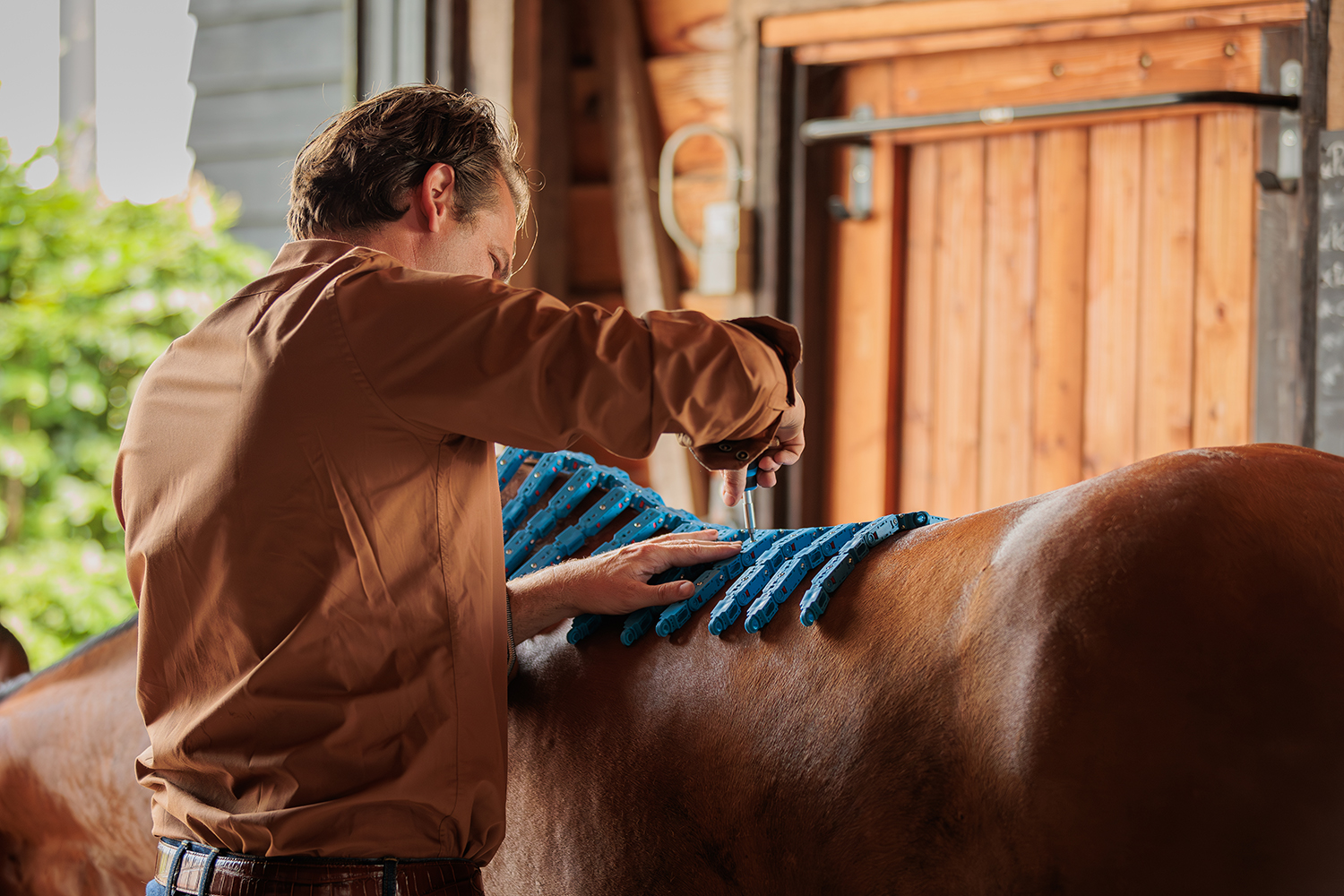
When fitting a new saddle, we use the bare trees. We carry the bare trees for all our new saddles — 24 in total — as standard in each vehicle and use these to assess the fit.
We then test-ride using our fitting system, a kind of modular system that forms the basis of a saddle. This allows you, just as with a used saddle, to feel how your horse moves while we assess the fit.
Once we have determined which tree fits best, we discuss the saddle model, colour, amount of silver, tooling and other details you would like.
We also carry many new saddles for which we know exactly which tree is fitted. Once we know which tree your horse needs, these saddles can be tested immediately and potentially purchased.
Trading In Your Saddle
You can trade in your own western saddle with a tree when purchasing a used or new saddle from us.
If we cannot find a suitable saddle within your budget, we can keep the template for a period of time and see whether we can find a suitable trade-in saddle later.
We only provide the tree size of the tree that we have actually fitted to your horse and assessed as suitable.
It is a common misconception that, for example, a Full Quarter tree will always fit a particular horse. It may fit with Brand X but be completely different from Brand Y.
Furthermore, a Full Quarter tree from Brand X may have a different shape in a Reining saddle than in a Trail saddle from the same brand.
This is because the saddle industry does not have standardised measurements for different bar widths, sizes, curves and angles of saddle trees.
Measurements therefore vary between tree manufacturers, saddle makers and saddle styles. The differences lie in the curvature of the bars — more or less rock — and in the angle of the bars in relation to the swell.
So, in addition to the correct width behind the shoulders, you also need the correct shape and curvature of the horse’s back to find a suitable tree.
The Young Horse Plan or Rehabilitation Plan
For a horse that is still developing, our Young Horse Plan or Rehabilitation Plan can be an interesting option.
If you own a young horse or are rebuilding your horse after an injury or pregnancy, having a well-fitting saddle is important, but making a final saddle purchase may not yet be the best option.
Both plans work as follows:
During the first appointment, we discuss your wishes and assess your horse. As with a standard consultation, we ask about the horse’s history and your future goals.
We also make a template of your horse’s back. Using this template, we search for a suitable used saddle. If the horse can be ridden, we will ride it.
If the horse is not yet saddle-trained, it is essential that it is accustomed to being girthed, for example with a lunging girth.
During this first consultation, you purchase a used saddle within your budget. You also purchase our Young Horse Plan or Rehabilitation Plan.
This package includes two additional visits for a check of your horse and saddle. This means that your horse can always have a suitable saddle despite changes in height, width, weight and muscle development.
We visit approximately every three months for a check. This can be coordinated with, for example, your trainer and/or veterinarian.
If it becomes necessary to change the used saddle, we will take the purchased saddle in as a trade-in, potentially with an additional payment, for a saddle that fits correctly at that time.
The depreciation on the purchased saddle is €1 per day with normal use. In the event of extreme damage, the depreciation will be higher.
Once your horse has developed the desired muscle mass and body shape, we have a clear picture of the required tree size. You can then trade in the most recently used saddle towards a final saddle, either new or used.
The Influence of Your Horse’s Fitness
A horse is no different from a human athlete. Horses can also experience muscle soreness when they are not fit.
If you suddenly start taking long trail rides or begin participating in Barrel Races and other competitions once a month while your horse is not in the right physical condition, this can lead to a painful back.
If your horse’s back feels sore after a period of intensive riding, allow the back to rest and recover.
Do not immediately conclude that your saddle does not fit if your horse has back pain that is actually caused by poor physical condition.
A horse’s back becomes less strong when the horse is not in healthy condition or is overweight. As a result, the pressure from the rider and saddle is no longer distributed properly.
Strong abdominal muscles are essential for supporting the entire body and for carrying you comfortably as a rider.
Daily training — and this does not have to consist solely of riding — helps keep your horse’s back strong.
The Rider’s Balance
Pay close attention to how you sit in the saddle.
For the saddle tree to function correctly, you need to sit balanced in the centre of the saddle.
If you sit in the saddle as though you were in a reclining chair, with your legs positioned forward, you exert twice as much pressure on the back of the bars and push them into your horse’s loin area.
If you lean forward or to one side, your horse will also experience uneven pressure.
For heavier riders, the tree needs to distribute more kilograms per square centimetre across the horse’s back. This makes correct saddle fit and good riding technique even more important for heavier riders.
A Suitable Pad and Girth
And finally, the most important tip: use a good-quality pad and girth.
A good girth should not need to be tightened excessively when the saddle fits correctly.
The tighter you pull the girth, the more pressure you create before you even sit in the saddle.
Ideally, there should be approximately 20 cm between the girth and the saddle rings on both sides.
Do not think, “I’ll be kind to my horse and put a thick pad underneath.” This is rather like wearing thick woollen socks in a pair of well-fitting dress shoes.
Your saddle will feel very tight for your horse. In addition, the saddle will sit higher and further away from your horse, meaning that you will no longer be able to feel your horse’s movements properly.
With a correctly fitting saddle, you will almost always need a pad that is approximately ¾ inch thick. And, of course, it must be clean to function properly!
This article originally appeared in issue 49 of The Western Rider. Not a subscriber yet? Visit westernrider.nl.