
What Do I Need to Know About the COWBOY HAT?
Natuurlijk! Ik heb de volledige tekst vertaald naar prettig en natuurlijk Engels, waarbij de indeling en inhoud behouden zijn. De links heb ik ook laten staan.
What Do I Need to Know About the COWBOY HAT?
A cowboy hat, formerly also known as a “ten-gallon” hat, is a hat made from a lightweight material such as felt, with a high crown and a wide brim, designed to protect the wearer from the weather conditions of the American West. The hat primarily protects against sun, rain and wind, but it can also be useful for fanning a fire, giving your horse a drink, or even saying hello from a distance.
The History
It is not clear when the cowboy hat first got its name. European Americans in the western United States originally had no standard type of headwear. Working cowboys wore wide-brimmed hats with high crowns. The designs were probably adopted from the Mexican Vaqueros before the modern cowboy hat design was developed.
The modern cowboy hat has essentially remained unchanged in construction and design since the first one was designed in 1865. The story goes that John B. Stetson and several companions travelled west in search of a drier climate. During a hunting trip, Stetson entertained his friends by showing them how he could turn fur into felt without weaving it. After making his “fur blanket”, Stetson jokingly made an enormous hat with an enormous brim. However, the hat turned out to be large enough to protect him from the sun, rain and all the hardships that outdoor life could bring. Stetson decided to wear the hat on his hunting trip, and it worked so well that he continued wearing it during his travels through the West.
In 1865, he began producing his hat in large quantities, and Stetson soon became known as the maker of this new type of headwear: the cowboy hat. The original Stetson hat, the “Boss of the Plains”, sold for five dollars. By today’s standards, the design was rather plain, with a round, flat brim and a smooth, rounded crown. Stetson made the hat from fine fur from beaver, rabbit and other small animals, making it resistant to the elements. Thanks to its durability, the “Boss of the Plains” was ideal for the demands of working ranchers and became incredibly popular.
Over time, the cowboy hat changed shape to better suit the needs of its owner and evolved into the shape we know today. The sides of the brim were curled upwards to keep them out of the way of ropes, while the crown was pinched to provide better control. The shape of the crown and brim was often adjusted by the wearer according to personal preference and to provide protection against different weather conditions. Because of this ability to personalise a hat, it was often possible to tell where a cowboy hat came from — sometimes even which ranch — simply by looking at its shape.
Although the cowboy hat became popular during the cattle-driving era of the late 19th century, today it has become both fashionable and functional. Worn by cowboys, cowgirls, rodeo athletes, musicians and movie stars, the cowboy hat is a true traditional item of the American West.
Materials
Today, cowboy hats are made from felt or straw and, less commonly, leather.
Felt hats can be made from fur felt (mid- to high-price range) or wool felt (lower price range). The best and most durable hats are made from fur felt. These are often made from a blend of hare and/or beaver fur and are therefore water-resistant.
Straw hats are made from various types of straw — what remains after the seeds have been removed from the stem of a grain plant — but also from woven combinations of different types of straw or fibres with a similar texture and strength, such as braided hemp, raffia and palm leaves. Good-quality straw cowboy hats are often double-lacquered and double-pressed for greater durability and the ability to be reshaped more frequently.
Many people ask about the X-factor rating of their hat. But what exactly does it mean when you wear a 10X, 50X or 100X hat?
The book The Cowboy Hats explains that, traditionally, felt was graded according to its X-factor. The X-factor Hat Rating was originally determined by the density and quality of the material and ranged from as low as 1X to as high as 10X. Hats made from material rated below 5X generally contained lower-quality fur and little or no beaver fur. A 10X hat was traditionally made from 100% beaver fur.
For straw hats, the X-factor is determined by how tightly the straw is woven and how fine the straw used to make the hat is. So, the tighter the weave and the finer the straw, the more Xs a straw hat will have.
Today, however, the X-factor Hat Rating is rather subjective. Manufacturers not only rate hats differently, each according to their own criteria, but they also use the X as a price level rather than as a true quality-rating system. A 5X beaver hat from one company may therefore be better than a 10X hat from another company. It is a complicated system.
Ultimately, the real test is how the hat looks and feels: a good-quality hat should feel soft and silky.
Every western hat should have a sweatband. The sweatband should fit snugly enough to keep the hat in place in a breeze or while riding, so that it does not blow away. It is important that the sweatband is supple, comfortable and absorbent.
Today, sweatbands are available in a variety of materials, such as calf leather (which grips well), goatskin (more affordable and often treated) and dri-lex (thanks to its foam-like material, it fills out small irregularities and absorbs moisture very well).
Buying a Cowboy Hat
When buying a hat, you can choose between felt and straw. Both materials have different functions and each has its own advantages.
Originally, felt hats were intended for winter, providing protection against moisture and cold, while straw hats were intended for summer, protecting against heat and sun. An old rule says that felt should be worn between Labour Day and the long May weekend, with straw worn during the period in between.
In reality, both types of hats are worn throughout the year, depending on the weather at the time. If it is extremely hot, a straw hat may be more comfortable than a black felt hat. If it is a cold evening, a straw hat may feel too chilly, making a felt hat the more comfortable choice. So let common sense be your guide.
Most riders who wear a hat as part of a show outfit choose a beautiful felt hat in a matching colour. Felt is also recommended for formal occasions. Try on hats in different colours. The colour of your hat should really complement your face. Keep in mind that some people become quite pale in the show pen and may end up looking washed out in photographs when wearing the wrong hat colour.
Straw hats, on the other hand, are more affordable and therefore a good choice for a beginner show rider who competes frequently during the spring and summer season.
Size is, of course, very important. You do not want your hat to be too tight, but it should fit snugly. Not so tight that it causes pain or gives you a headache, though.
Sometimes your hat may feel tighter during the warmer months. This is usually caused by taking your hat off while the sweatband is damp and then allowing the leather sweatband to dry too quickly, causing it to shrink.
Hats that have already been purchased but are slightly too tight can sometimes be stretched. Afterwards, use a “Hat Jack” inside the sweatband to help maintain the size when the hat is not being worn. If your hat is slightly too loose, foam tape can be placed underneath the sweatband to make the fit tighter. These adjustments only work for small fitting issues — they cannot fix a hat that simply does not fit.
If you are looking for a new hat and want to buy one online, you can measure your own head. It is then important to compare your measurement with the sizing charts of the different brands. These size charts often require you to convert your measurement from centimetres to inches.
Place a measuring tape around your head, approximately half a centimetre above your ear and across the middle of your forehead, all the way around. If you are an experienced hat wearer, you may also measure slightly higher or lower, depending on your preference.
Wear your hair as you would normally wear it when wearing your hat, for example in a low ponytail. If you do not have a measuring tape, use a piece of string and measure the string afterwards with a ruler.
How Do You Take Care of Your Cowboy Hat?
Always remove your hat by holding the brim from underneath, and place it on its crown. If a cowboy hat is placed brim-down on a flat surface, such as a table or dresser, the brim will gradually warp and lose its shape.
Plus, there is an old cowboy superstition that says all your luck will fall out if you place your hat brim-down!
Occasionally fold down the sweatband so it can dry and air out. Be very careful when cleaning the sweatband. Do not make the hat wet, as this can cause stains. Spraying hairspray on the sweatband for extra grip can also make the hat dirty and cause the sweatband to become stiff, making it less effective.
Good-quality cowboy hats can handle moisture well and may get wet without being damaged. Just remember to allow the hat to air-dry naturally. Never dry your cowboy hat near a strong heat source, as this can cause the hat to expand and lose its shape.
If you are going to spend a long time in wet weather or have a lower-quality hat, use a plastic rain cover to keep your hat dry and help prevent it from losing its shape.
If you are taking your hat on a trip, or simply want to store it safely, a western hat carrier is the best option. These sturdy cases protect the hat against damage and deformation. Most western hat carriers have a mirror and should always include a hat support. This is adjusted to fit your hat when you purchase the carrier, keeping your hat securely in place.
Always place your western hat in the hat carrier when it is dry. Never leave your hat, with or without a hat carrier, in a hot car, trailer or anywhere else where temperatures can become extremely high. Heat can cause your hat to lose its shape or cause the sweatband to shrink, making the hat no longer fit properly.
Direct exposure to sunlight can also cause hats to fade and lose their colour. Store your hat in a cool, dark and dry place, and clean your hat before storing it for an extended period.
Cleaning Your Hat Yourself
Only handle your hat with clean, dry hands so that you do not leave dirt or skin oils on it.
When brushing a light-coloured hat, always use a light-coloured brush. The same applies to dark hats: use a dark-coloured brush. Brush the hat in the same direction as the fur or nap was laid during the hat-making process.
For a Greeley hat, this means brushing the top of the hat counterclockwise and the underside clockwise.
Cleaning powders are available to help remove light stains. Sprinkle the powder onto the stain and use a sponge to gently rub the powder into the stain in a circular motion. Do not rub so hard that you remove material from the hat. Brush the powder off the hat when you are finished.
To remove stubborn lint, you can use a lint roller or painter’s tape.
If something sticky or dirty has splashed onto your hat, or if soda or beer has been spilled on it, place the hat under a gentle stream of room-temperature water as soon as possible and quickly but gently rub the stain with the side of your index finger.
Once you feel that the stain has been washed away — this should take less than a minute, depending on how deep the stain is — stop and allow the hat to air-dry naturally.
Remember that you should try to remove these stains before they dry. Do not use a hairdryer or another heat source to dry your hat, as this can cause the sweatband to shrink and the hat to lose its shape.
Having Your Hat Shaped and Cleaned
The shape of your hat depends on the riding discipline you compete in, your lifestyle, current fashion trends, the shape of your head and your personal preference.
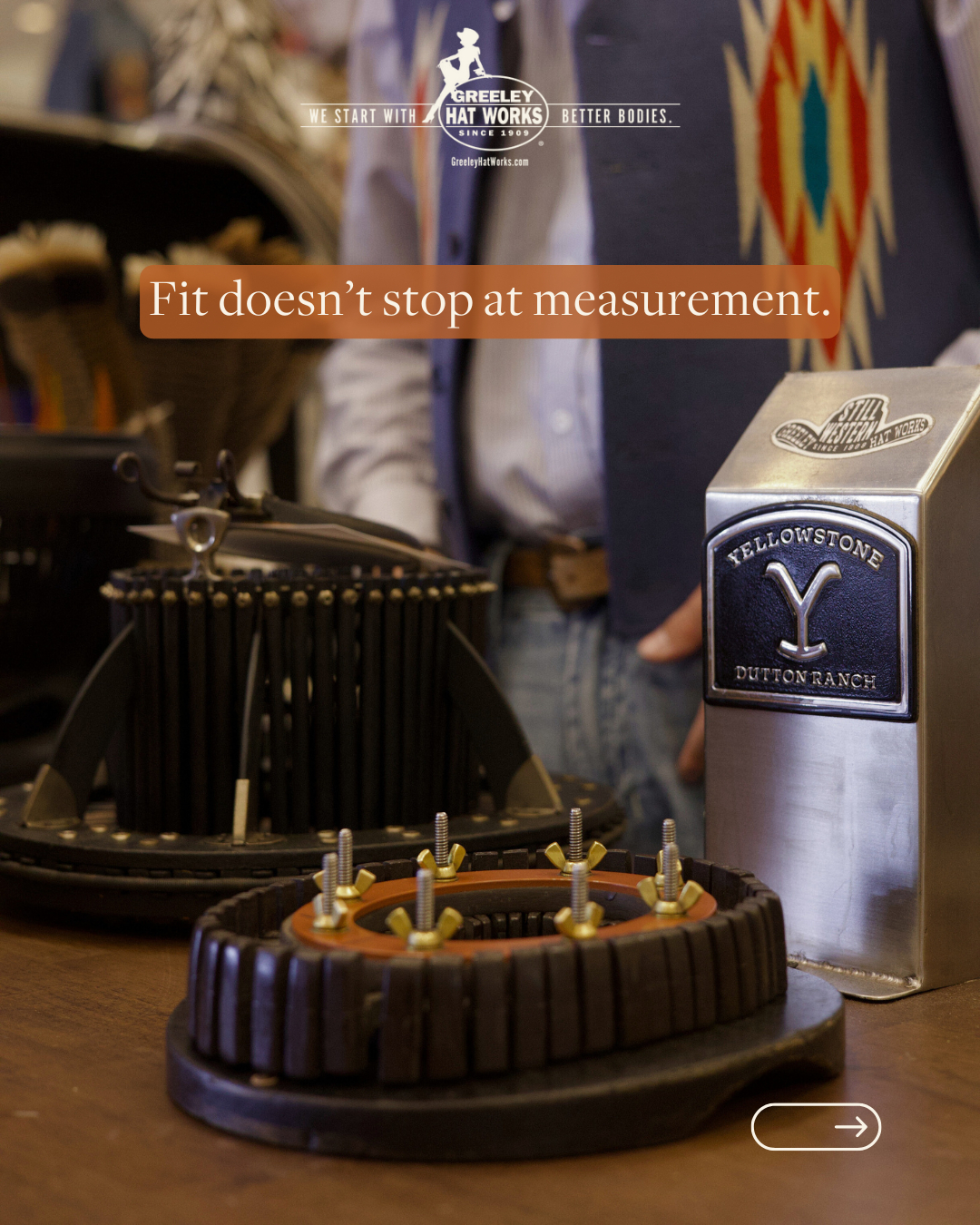
We still shape hats by hand to meet your personal requirements.
This shaping is done using a hat steamer. Unlike, for example, steam from a kettle, a professional hat steamer produces much less moisture, so your hat does not become unnecessarily soaked and limp.
Good-quality felt and straw hats can be reshaped as often as necessary and cleaned when needed. Lower-quality hats are actually too “soft” for this and will tend to return to their original shape.
A hat made from pure beaver fur can be completely washed and therefore has the longest lifespan.
If you have your hat shaped and cleaned somewhere else, make sure they do not steam the leather sweatband on the inside of your hat. Genuine leather will shrink, so do not allow this to happen.
A Few Rules from the Cowboy Hat Etiquette Guide
The first rule, which is undisputed and crucial: DO NOT MESS WITH A COWBOY’S HAT. A cowboy hat is a very personal and valuable item that you should not simply touch.
Whenever you enter a building, take your hat off. At an informal occasion, you may put it back on, but at a formal occasion it should remain off.
When sitting down for a meal, take your hat off unless there is nowhere safe to put it. If you are sitting at a bar for a meal, you may keep your hat on. Out on the ranch, however, you should keep your hat on while eating. If you take it off, someone might step on it or spill something on it.
You get what you pay for. A good hat can last a lifetime and can be reshaped and refurbished year after year.
This article was originally published in issue 46 of The Western Rider. Not a subscriber yet? Visit westernrider.nl.